Introduction
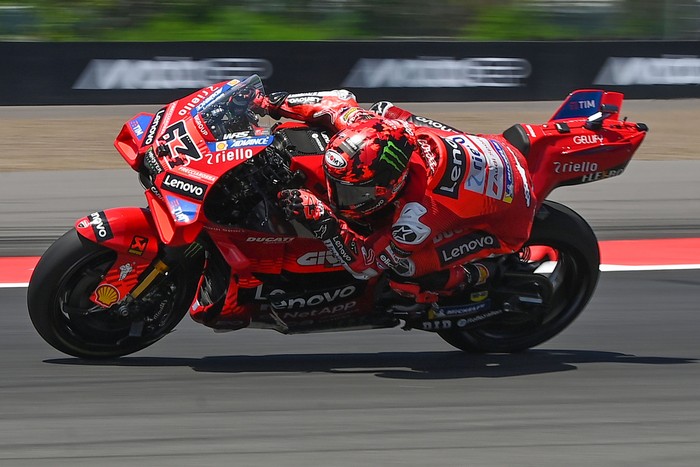
Francesco ‘Pecco’ Bagnaia’s performance at the MotoGP Mandalika last weekend starkly contrasts with his dominant display at the previous round in Japan. While Bagnaia swept both the sprint and main races in Japan, his results in Mandalika were disappointing, finishing last in the sprint race and crashing out in the main event.
Performance Analysis
Bagnaia’s dominance in Japan highlighted the potential of Ducati’s 2024 components, which were reportedly used during the Japanese GP. The advanced aerodynamics and power delivery of the Ducati Desmosedici GP23 played a pivotal role in his victories. However, the mysterious underperformance in Mandalika raises questions about the adaptation of these new components to varying track conditions.
Technical Insights
The Ducati Desmosedici GP23’s engine configuration, featuring a 90-degree V4 layout, is renowned for its high RPM and power output. The integration of 2024 parts likely aimed to enhance traction and stability, which proved effective in Japan. Yet, the inconsistent results in Mandalika suggest that further optimization is needed for diverse track layouts and weather conditions.
Conclusion
Bagnaia’s inconsistent performance underscores the importance of thorough testing and component adaptation in MotoGP. As Ducati continues to refine their 2024 package, the team must prioritize consistency across different circuits to maintain competitive edge. The ‘From Hero to Zero’ narrative of Bagnaia’s Mandalika performance serves as a reminder of the unpredictable nature of motorcycle racing and the need for relentless innovation.